

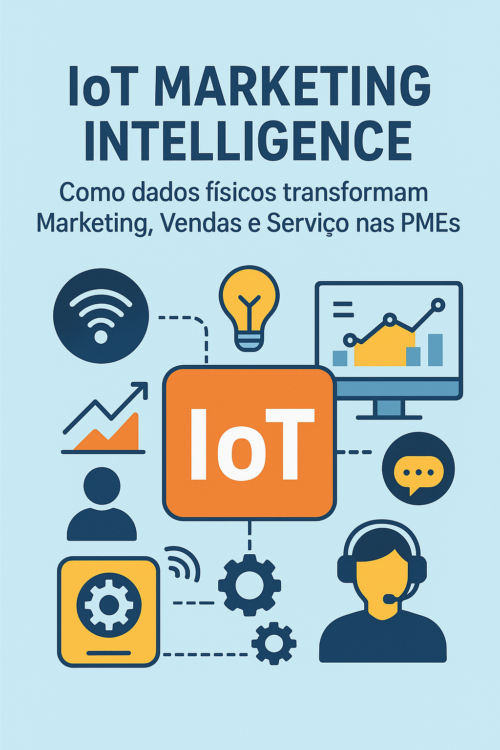
From Invisibility to Action: Sensors, AI, and Automation Creating a New Layer of Data for Business Growth
The Marketing and Sales systems of SMEs have been operating in a flat world. They work with a universe of digital data: website visits, campaign clicks, CRM entries, email opens. These metrics are valuable, but they tell only half the story. The other half — the real physical behavior of customers, operational flows, engagement with products and spaces — remains an invisible and unexplored territory. It’s like making strategic decisions by looking only at the shadows of objects.
This gap between digital and physical creates silent losses: sales opportunities that enter and leave the store without a trace, marketing campaigns disconnected from real point-of-sale behavior, and service operations that react to problems instead of preventing them.
IoT Marketing Intelligence emerges to fill this void. This is not a futuristic and distant technology, but a practical and accessible approach implemented by loqua.marketing for SMEs. Through the strategic integration of sensors (RFID, BLE, environmental), AI-powered computer vision, and automation platforms (like n8n and Mautic), we create a new layer of operational data that transforms physical information into intelligent actions in CRM, Marketing, and Service.
The Root of the Problem: The Invisible Data That Creates Costs and Loses Revenue
Applying an 80/20 logic, we identify four critical points where the lack of physical data generates inefficiency:
- Marketing Blind to Physical Space: Decisions about campaigns, merchandising, and content are made without insights into real presence, movement patterns, engagement with zones, or peak hours.
- Sales with Partial Vision: A lead or client can visit the store repeatedly, show physical interest in a product, but the salesperson receives no alert and the CRM remains empty of this crucial history.
- Reactive, Not Predictive Service: Queues form without alerts, waiting rooms get crowded, equipment operates under suboptimal conditions – all because there are no sensors generating data to anticipate and adjust.
- Manual and Disconnected Operations: The team spends valuable time on manual logging, visual monitoring, and generic activations, instead of relying on contextual automations triggered by the environment.
The Intelligence Engine: How It Works in Practice
The solution is structured in three main layers that transform raw signals into actionable intelligence:
- Sensing – Capturing the Real World: Discreet sensors collect anonymous, structured data. Presence sensors (BLE/RF) map people flow; AI-powered cameras analyze counting, heatmaps, and queues (without facial recognition); environmental sensors monitor comfort; proximity devices track interaction with products. The principle is to capture simple signals that infer complex insights.
- Edge Processing – Intelligence on the Ground: Mini-servers (like Raspberry Pi) process data locally. They identify events (entry/exit), calculate dwell time, detect patterns and anomalies. This ensures privacy (raw data doesn’t leave the premises), low latency (response in milliseconds), and reliability (works even without internet).
- Operational Orchestration – The Unified Ecosystem: The processed events are sent to the system’s core:
- To n8n, which triggers automations: “if client X entered the store, create a task in the CRM”.
- To Mautic, which launches contextual campaigns: “client who visited zone Y receives an email about product Z”.
- To the CRM, which enriches the lead’s profile with physical history.
- To Metabase, which displays real-time dashboards on customer behavior and operational efficiency.
Use Cases That Generate Real Results
- For Marketing: Re-engagement campaigns triggered when a customer returns to the physical space after a period. Store layout optimization based on real heatmaps. Personalized WhatsApp messages (via Chatwoot) based on the store zone where the customer is.
- For Sales: Audio/discreet alert for the salesperson when a VIP client or a hot lead enters the store. Hybrid lead scoring: digital interest + frequency of physical visits. Analysis of the physical sales funnel: in which zone do customers stop most and where do they drop off?
- For Service: Automatic queue management with AI vision, informing average wait time. Predictive alerts for maintenance based on equipment vibration or temperature. Staff scheduling optimization according to real on-site movement patterns.
Tangible Gains: Revenue, Cost, and Experience
Deploying this layer of intelligence has a direct impact on results:
- Increased Revenue: More conversions through perfect timing and personalization based on real behavior.
- Reduced Costs: Fewer manual monitoring hours, optimization of resources (energy, staff), and prevention of operational failures.
- Superior Experience: Customers perceive a more fluid, agile, and tailored service, increasing loyalty.
Conclusion: IoT as a Practical Resource for SME Growth
IoT Marketing Intelligence democratizes access to high-value operational data. With loqua.marketing’s methodology, SMEs can integrate sensors, automation, and edge AI in an accessible, scalable, and results-focused way. It stops being an abstract concept and becomes the engine for smarter Marketing, better-informed Sales, and truly proactive Service.
Bring This Intelligence to Your Company in Two Ways:
1. With the MKT GO 💪 Package – The “Turnkey” Solution
Ideal for those who want results without complexity. We include a standard sensor installation, ready-to-use dashboards in Metabase, and plug-and-play automations in n8n and Mautic. You receive a complete, operational system with continuous maintenance to start acting on physical data immediately.
Practical Example: An automatic alert to the manager when in-store traffic peaks, suggesting activating a flash promotion on the digital display.
2. With the RevOps ON 🔥 Program – The Empowerment for Autonomy
Ideal for companies with an internal manager who wish to empower their team. We train your employee to configure sensors, create automations in n8n with IoT events, and interpret advanced dashboards. You gain an internal operator capable of managing and optimizing the entire ecosystem of physical and digital data.
Training Example: Your manager will learn to build a workflow that, from a proximity sensor, updates a lead’s score in the CRM and automatically schedules a demonstration.
Ready to transform invisible data into your greatest competitive advantage?
[Talk to a loqua.marketing specialist and discover the best approach for your business.]
